Showing posts with label Carlos Aguilar. Show all posts

Monday, March 9, 2015

Tasmania Tourism Developments

There is an interest for expanding tourism in world heritage sites and national parks in Tasmania. The Hodgman Government expressed wanting to expand the different kinds of ways people can be involved with these environments. In particular, six proposals have moved on to the stages of becoming something that's actually possible. A particular activity that could potentially be implemented involves Cradle Mountain Canyons. In this area, people have proposed flying tourists to a remote river at Cradle Mountain, and then allowing them to jump and rappel down the waterfall. Another idea was to build a standing camp on Halls Island in the Walls of Jerusalem Natural Park. This would be accessed by sea planes, which sounds really awesome and fun! There have also been plans to expand lodges that already exist by adding cabins, such as in Freycinet Lodge. The remaining proposals should be revised by the middle of the month, and then it would be decided whether or not they are implemented. One interesting thing that came about from this was the fact that there was no limit on the number of accommodation facilities allowed under the World Heritage Management Plan. There are concerns as to what kinds of drawbacks there are to making these ideas a reality. Some believe there would be an increase of people in these areas, and it would be a determine to the ecology that has been preserved. Ultimately, those who are for the creation of these tourist attractions want Tasmania to be the environmental tourism capital of the world!

Sources:
Source 1

Sunday, March 1, 2015

Controversy in Tasmania

In my last presentation, I spoke briefly about a controversy that has happened relating to preservation of Tasmanian wildness. In this post, I thought I would expand on that and talk a little bit more about what happened and what it means. To start off, this controversy is about deforestation in Tasmania and the illegal activities that went in regarding the whole situation. In 1989, a man by the name of Eddie Rouse was the chairman of a logging company named Gunns. At the time, elections were going on and he felt that his logging profits could be hurt if the laws changed. This was due to the fact that it was a possibility for the Labor-Green government to be elected. This would mean that there would be a moratorium on loggings in estates where areas were not already approved. Along with this, there would be a limit on the state's wood chip export quota, as well as closing some mills and preventing others from expanding.

The controversy comes with the actions of Eddie Rouse. In fearing the decrease of his profits, he attempted to bribe a member of the Labor (Jim Cox) to cross the floor. The money that was at stake was him losing 10-15 million dollars. If his bribes were to have been taken, they would have allowed the Liberal Party as well as Robin Gray (leader of the party) to resume power. Surprisingly, there was no evidence found that Gray was a part of this whole ordeal. Following these bribes, Cox did the right thing and went to the police to report Rouse. They then tapped his phone called to Cox and arrested him on June 23. He was sentenced to 3 years in jail, but only served 18 months. I found it very intriguing that Cox was so committed to his cause, and in being so, he ended up winning through reporting Rouse.

Sources:
Source 1
Source 2

Tuesday, February 17, 2015

Tasmanian Blue Gums

The Tasmanian Blue Gum is Tasmania's state flower. Its scientific name is Eucalyptus glololus Labill. These flowers are larger than those of other Eucalyptus trees, and are present in the axils of the leaves. As Jory had presented, the flower is a lot of white stamens arranged in several rows near the outside. There's a thick nectar-secreting disk that extends near the top of the ovary. This flower blooms in early summer. The Tasmanian Blue Gum is found throughout the state of Tasmania, including the Royal Hobart Botanical Gardens.

Currently, the tallest Eucalyptus in Tasmania is 298ft tall. The Blue Gum can also be used widely for a variety of things, including essential oils that are extracted from the flower and can be used for perfumes or therapeutically. People are use it for tea and bees use it as a good source of nectar for their honey. The history of the flower dates back to 1799 when Jacques de Labillardière, a french botanist, who got it from the south-east coast of Tasmania. It's name comes from the features which it exhibits, glob-like and spherical. 

Sources:
Source 1
Source 2

Thursday, February 12, 2015

The University of Tasmania

Coming from Stanford, I thought I would take a go at finding out what kind of the University of Tasmania (UTAS) was like. To start off, UTAS is a public Australian university officially found on January 1, 1890. Stanford is 5 years older, as it was found in 1885. UTAS was the 4th university in Australia, and it is currently the ONLY university in Tasmania. The student population is at 26,800 with about 6,000 internationals and 1,000 PhD students.

UTAS was found after some money was allocated to it's construction following the abolition of overseas scholarships. It stands in the Queens Domain in Hobart. One interesting fact is that the first PhD given out was to a woman by the name of Joan Munro Ford, in 1945. The university has three main campuses, which are: Sandy Bay, Newnham, and the Cradle Coast campuses. Each of them have specialties that are like center for arts, center for sciences, etc. They also have various departments that you would expect at a typical university. They have fine arts, a school of medicine, education, physical and biological sciences and a plethora of others! They all rank 30 and up nationwide.

Aside from this, I also read it was a good research university. This is so due to its prime location which allows many to visit places with such great diversity and needs to research. This year, actually, UTAS will have its 125th anniversary! I found this article interesting when comparing it to Stanford since we are in such different locations. Although there isn't much a difference in terms of structure, it would be really cool to visit and talk to students about what their experience has been like!

Sources:
Source 1
Source 2

Tuesday, February 3, 2015

Poppy Seeds in Tasmania

July is the time for the sowing season for opium poppies in Australia mainland and Tasmania. It is prime time for planting them, so that in November, their shells are left behind with the poppy seeds that are oh so famous. At this point, there is a latex that surrounds them, which dries two months later when it's ready to be harvested. When this occurs, the poppy seeds and latex are separated and the seeds get taken to be processed for foods, whereas the latex gets ground up to be extracted for its valuable narcotic alkaloids. Tasmania is actually the start of a global business which profits $12 billion a year in opiate painkillers. Half a century of breeding and good climate has made this plant something the state can benefit from financially. It grows 85% of the world's chemical that is used to make OxyContin. Another chemical is produces, though, is used to treat heroine overdoses as well as other kinds of addictions. The downside of this is that it also makes most of the world's morphine and codeine, which are two extreme painkillers that are widely used illegally. The companies running these productions are trying to make it so that they can cultivate better, genetically modified poppies in the mainland. On one hand, they want to do this in order to increase profit, but on the other, they are against it because it can contribute to a rising global drug abuse problem. This industry can be tracked back to Tasmania all the way until the 1950's. Through the world wars, there was a huge use of mophine to aid soldiers who were injured, but they kept running out since there wasn't a huge supply. As a result, they started coming up with better ways to extract it and with it came the production of heroine. Through the years now, it has come to be more controlled since the companies that work with the poppy seeds have limited the industries they supply.

Sources:
Source 1
Source 2

Tuesday, January 27, 2015

Weather Patterns in Tasmania

As we approach our trip, I started to get more interested in how the weather patterns of Tasmania differ to those here, at Stanford. Overall, Tasmania has a cool temperate climate. There is actual snow sometimes in the mountains of Tasmania during their winter, which is out Summer. Most people, however, live near the coast. As a result, they don't get too much heat or humidity when summer hits. When we arrive in August, we should expect to see some temperatures around 60 celsius. Throughout our stay in Tasmania, my sources say the temperature should remain somewhat constant at around 60 celsius also. This will be true of Hobart, Launceston, Devonport, Swansea, and Strahan. The temperature is coldest there around July and August, so we should miss that. Regardless, it is probably smart to take a lot of warm clothing in order to survive these harsh winters (to all those of is from SoCal!). In terms of rainfall, it is spread out fairly evenly throughout the year, but we should expect a tiny bit of it since it supposedly is most wet over the winter months. The west has the most rain, and the east lies in the shadow of it. Although this is the second driest capital in Australia, it does not suffer from these climates because it is near a reservoir.

Sources:
Source 1
Source 2

Tuesday, January 20, 2015

Elephant Seals in Tasmania

Of all seals, Southern Elephant Seals are the largest. Males reach 4-5 meters and 4850 pounds, and females can be 2-3 meters long and 1102 pounds. Males have large trunks, called proboscis, which is used to strengthen their vocals--reason number one as to why they are called elephant seals. Despite their enormous size and weight, if tampered, they are to be feared because they can move at incredible speeds (5 miles per hour!). In Tasmania, elephant seals used to breed in on King Island (top left island) before they got slaughtered and wiped out by the sealing industry. Currently, only about 3 elephant seals are spotted on Tasmania each year that range from under a year old to about sixteen years old. The reason they have been spotted here is because their main source of food is squid, which can be found in the deep Antarctic waters. Southern Elephant Seals tend to stay in these places when they are ravaging for food for months, and it is until they have to breed that they go elsewhere because they have another breeding ground. They go to Macquarie Island, where, unlike Tasmania, there is an estimated population of about 86,000 elephant seals. Southern Elephant Seals tend to stay underwater for 85-90 percent of their life. Unfortunately, these seals are listed as endangered on Tasmania's threatened species list. Although in the sea their main predators are great white sharks and killer whales, they have none on land (besides humans, of course).

Sources:
Source 1
Source 2

Tuesday, January 13, 2015

Roadkill in Tasmania

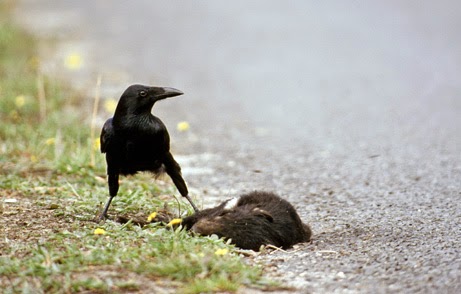
We've talked a lot about the roadkill in Tasmania, but I think it's time to get to talking about the numbers! Every year, about 500,000 marsupials, birds, and reptiles are killed on Tasmanian roads. Imagine how much work that is for a taxidermist! This number is a rough estimate, though, since some animals are eaten by others and go uncounted for. Tasmania has the largest number of roadkill in Australia, and these numbers mean that essentially, there is a dead animal to be seen on the road every 2-4km or so, but the number is larger in areas where there are more animals near roads and thus, more deaths. This issue is so prevalent, that in some locations, animals have become extinct! This doesn't mean they are extinct entirely, just in specific locations. Some of these animals include Quolls and Bandicoots. The reasons that animals are so attracted to the road could vary. Animals like reptiles like the warmth, and since roads are good at absorbing it. Insects are also attracted to this warmth, and in turn, Quolls are because they eat insects. Other contributing factors include the fact that it's easier for animals to travel on roads than to go through dense forest and bushes--as well as the very obvious fact that humans intercept their lives and build roads in the middle of their usual terrain. The reason this exists on such a huge scale in Tasmania is unclear, but predicted to be because there is a lot of prevalence of the animals there. The kinds of animals killed are also killed at the most inopportune times, such as night because their fur is black and this unnoticeable to a driver. Some things that can be done are drive safely and slowly, watching for shadows and movement, not assuming animals will move, swerving, and generally beware of your surrounding so to prevent this.

Sources:
1. http://www.wildlifematters.org.au/Roadkill.htm
2. http://gadling.com/2009/04/02/tasmania-roadkill-capital-of-the-world/

Friday, January 9, 2015

How Tasmania got to be Called Tasmania

About 12,000 years ago, Tasmania was cut off the mainland of Australia and the Aboriginal people living there remained isolated. They developed differently than those that remained on the mainland, as far as culture and physicality is concerned.  In 1642, Abel Tasman found the land and named it after his higher-up, Anthony Van Diemen. Before this, the people of Tasmania knew their land as Trowunna. Although Tasman named the land after his superior, the actual name of Tasman started to catch up instead. A naturalist in 1803 named a plant Tasmannia Ianceolata. A couple of mapmakers in 1808 also named their map both Van Diemen Land and Tasmania, which is the first time Tasmania was discovered in print. By the 1820's the name had become what people had started using. Following that, there was a book published that stated Van Diemen Land should be called Tasmania instead, and then some form of currency was printed with the name Tasmania on it, as well as other characterizes images-- such as kangaroos, of course. The name just started becoming the norm and maps, clubs, newspapers, etc. started using the name. People also started to use the name Tasmania because the name Van Diemen Land brought about a negative connotation, since people were aware of what had happened to the people of Tasmania. In 1855, the name was officially changed through Queen Victoria. It became officially used January 1, 1856 and was celebrated at a Grand Tasmanian Regatta. 

Sources: