Showing posts with label Aaron Peterson. Show all posts

Friday, March 20, 2015

Marsupial Lions and Monster Kangaroos: Australia's Vanished Fauna

At the end of the Pleistocene, Australia was still home to an extraordinary range of marsupial megafauna. These animals evolved independently from the rest of the placental world for millions of years, which is why it is so fascinating to see both how diverse and unusual they became and how similar some of them appear to placental mammals in both physiology and ecology.

 Thylacoleo, also known as the marsupial lion, was one of the largest predators in the Australian continent at up to 130 kg. Pound for pound, it had the strongest bite of any mammal, living or extinct. With retractable claws like a cat, semi-opposable thumbs and a stiff kangaroo-like tail, not to mention massive carnassial cheek teeth for tearing flesh, it would have made a fearsome predator, and were it still alive would probably make our trip to Tasmania a lot more dangerous.

Diprotodon was the largest marsupial of all time, weighing in at a massive 2800 pounds, the size of a rhinoceros. Related to both wombats and koalas, Diprotodon probably behaved more similarly to a rhino or hippo, living in forests, woodlands, and grassland, grazing on vegetation and possibly staying close to waters. Diprotodon has been claimed as the basis behind the legendary bunyip of Aboriginal myth, and cave paintings exist that may depict both Diprotodon and Thylacoleo. 

Kangaroos were not immune to gigantism. Procoptodon reached 6.6 feet in height, and probably walked rather than hopped. Kangaroos also took on some niches we might have trouble imagining: the earlier (Pliocene) Propleopus oscillans had large shearing teeth which indicate it might have eaten meat.
Artist's recreation of Thylacoleo attacking Diprotodon. 
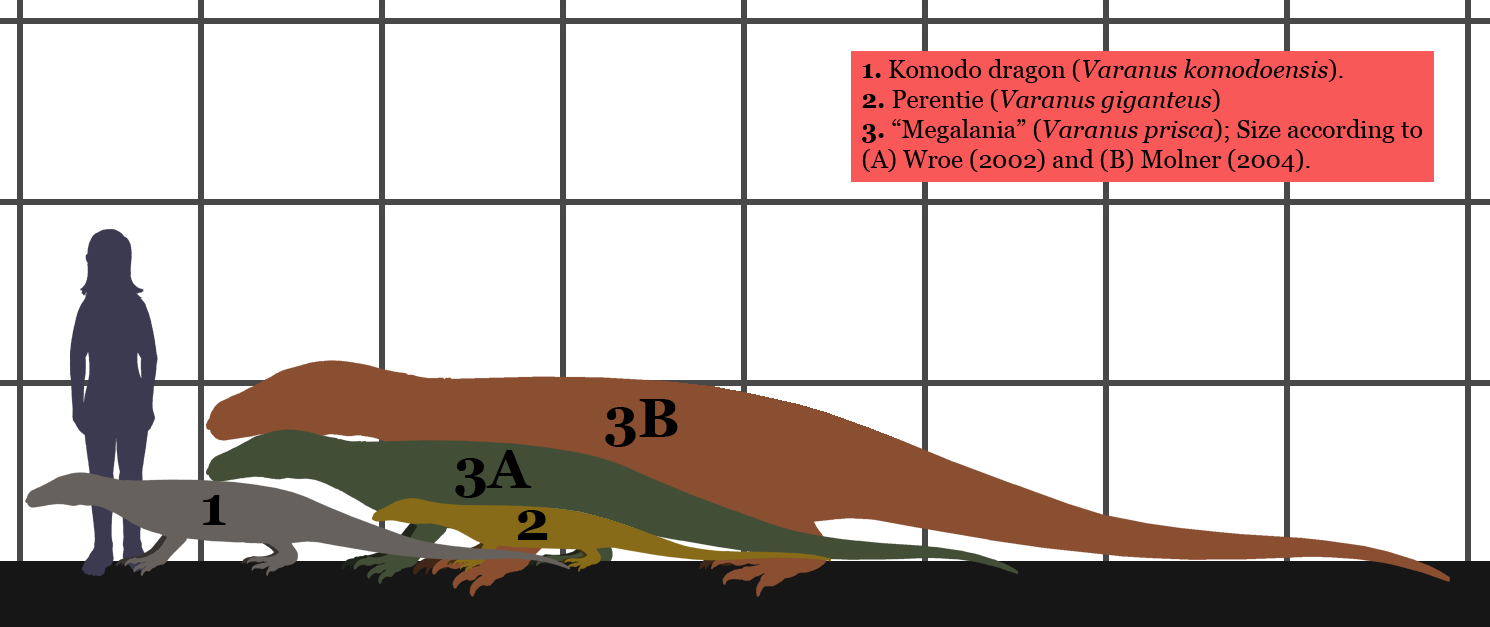
Finally, amidst all these marsupials there is one reptile that deserves our attention. We might know of the Komodo Dragon as the largest lizard in the world, but when the first Aborigines arrived in Australia, they had to deal with Megalania. At up to 20 feet in length Megalania was the largest lizard of all time, and undoubtedly the top predator anywhere it lived.

These are all examples of island gigantism and convergent evolution. Without big cats or ungulates, marsupials and reptiles evolved to huge sizes to fill these niches.

http://en.wikipedia.org/wiki/Megalania
http://en.wikipedia.org/wiki/Thylacoleo
http://en.wikipedia.org/wiki/Diprotodon

Saturday, March 14, 2015

Mount William National Park

Mount William (Wukalina) National Park is an 8,640 hectare park in far north-eastern Tasmania. It looks absolutely beautiful. Activities include boating, swimming, hiking, and camping. The spectacular Bay of Fires is part of the park, and visitors also have a chance to see Forester Kangaroos, Bennett wallabies, pademelons, wombats, echidnas, devils, and possums, along with a variety of bird species, including yellow-tailed cockatoos, honey-eaters, wedge-tailed eagles, and albatross.

http://www.parks.tas.gov.au/index.aspx?base=3634

Friday, March 13, 2015

Do Tasmanian Animals Hibernate?

When I realized our trip was planned for the winter, I was initially concerned that the season would affect our chances of seeing some of the wildlife, since they would be hibernating for the winter. Hibernation is a state of lowered metabolism marked by lack of activity. In mammals it is characterized by a low body temperature and sometimes dramatically lowered breathing and heart rate. Common animals that hibernate include ground squirrels and other rodents, hedgehogs and other insectivores, some mouse lemurs, and bears, although the latter experience a less dramatic drop in body temperature.

It turns out that most marsupials don't experience full-blown winter hibernation. Some, like the dunnart and the pygmy possum, experience a daily or multi-day torpor, which is like a mini-hibernation.

A sleepy echidna

One Tasmanian animal that does curl up for the winter is the short-beaked echidna, which isn't a marsupial but a monotreme or egg-laying mammal. In the autumn and winter, echidnas will burrow into the ground and hibernate for several months, during which their body temperature can fall to as low as 5 degrees C. They're actually have the slowest metabolism of any mammal, about 3
0% of that of placental mammals (that's even slower than sloths!). Luckily, we'll be there in spring, and most of the echidnas will have woken up by then (not that we're particularly likely to see them in the wild anyway, but at least we have a chance).

http://en.wikipedia.org/wiki/Hibernation
http://en.wikipedia.org/wiki/Short-beaked_echidna
http://www.nature.com/news/2009/090105/full/news.2008.1344.html
http://espace.library.uq.edu.au/view/UQ:9717/hib_by_echidnas_.pdf


Monday, March 2, 2015

Convict Women and Children

History has had a tendency to focus on male stories to the detriment of women, and the story of Tasmania's convicts is no exception. When we think about the early days of the British convicts sent to Port Arthur, we usually imagine men, and career criminals at that. However, between 1803 and 1853 over 12,500 women and 2,500 children were sent to Tasmania (and countless others to the Australian mainland). Often their crimes seem minor (petty larceny, theft of a few pounds, in one case theft of a few geese), though at least a few women were guilty of murder. Their first stop was often Hunter Island, off of Hobart, where they were assigned to the Female Factories or workhouses for the duration of their sentence. Tasks included needlework, washing, barrack duties, carding wool, spinning, cooking, or working as hospital attendants. Punishments were harsh: a months hard labor was a common punishment for refusing to make a bed, for instance, and other punishments included beatings, cell confinement on bread and water, and having to wear an iron collar for a month. Convicts could apply for tickets of leave or free pardons from the government to leave the factories; these could be denied for such reasons as absconding, being absent from muster, or being pregnant. They had to apply to the government to obtain for permission to marry, which was frequently denied.

While some of the children sent to Tasmania were convicts themselves, others were orphans or the children of female convicts. Orphan schools were sometimes set up to provide for their education.

The Female Convicts Research Center (second link below) is an institution devoted to researching and remembering the lives of these women. This looks like a formidable task, since many of the women changed their names and disappeared from written records after obtaining their freedom. Still, they have an impressive collection of data, including fascinating stories of individual women. It's definitely worth checking out if you find this type of history interesting!

               A successful ex-convict family. 

Also, in case you're wondering how all this is relevant today, apparently up to 74% of Tasmania's current population is descended from convicts.
http://www.abc.net.au/news/2015-02-24/footsteps-towards-freedom-art-project-begins/6251596
http://www.femaleconvicts.org.au/index.php/about-us/photos
http://www.linc.tas.gov.au/research/browse-by-category/familyhistory/convict
http://www.alisonalexander.com.au/index.php/books/tasmania-s-convicts


Saturday, February 21, 2015

Maria Island

Four kilometers off the Eastern Coast of Tasmania lies Maria Island. Named after Governor Van Diemen's wife, Maria, the entire island is now a national park, with no permanent inhabitants besides a few rangers. It is home to a wide variety of bird species, including Swift parrots and forty-spotted pardalotes, as well as possums, wombats, pademelons, and short-beaked echidnas. In 2012 a population of healthy cancer-free Tasmanian Devils was introduced as a contingency population; the population has been so successful it has raised concerns about the devils' impact on the native island birds.
Shoal Lagoon in Maria Island

Maria Island also features the spectacular Painted Cliffs. The cliffs were formed by iron oxide-laden water trickling down through sandstone over millions of years, and gradually being eroded by waves and sea spray.
Another cool feature is the Oast House, built during the second convict period (1844-5) for drying hops. 
Tourists can take a ferry and visit! We're not scheduled to go but if anyone is staying longer in Tasmania it might make a fun trip. 

Sources: http://www.parks.tas.gov.au/?base=1490
http://en.wikipedia.org/wiki/Maria_Island 

Monday, February 9, 2015

Fox Eradication A Costly Failure, But Not For The Reasons You Expect

          In 1998 a stowaway fox hopped off a ship in Burnie, Tasmania. It was spotted sniffing around a local beach before darting away into the bush, and was never seen again. It almost assuredly had no idea how much trouble it was about to cause.
          Foxes are a pest in mainland Australia. This is actually a huge understatement; after colonists introduced them in 1845, hoping to shoot them for sport, the population exploded. Today, Melbourne has up to 16 foxes per square kilometer, for a total around 7 million nationwide. They devour native animals, eating birds at a stunning estimated rate of 361 per minute.
           Tasmania has thus far been spared this devastation, which is why so many species like bandicoots, quolls, devils, and birds still thrive there. Therefore, it makes sense on the surface that Tasmania would make a herculean effort to remain fox-free.

           However, the Fox Eradication Program launched in 2002 has brought harsh criticism, and it is not difficult to see why. For one, the number of foxes in Tasmania is and has always been extremely low, quite possibly zero. While occasional stowaways have been found like the one in Burnie, there is no evidence that a breeding population has ever existed. Secondly, the FEP received $5 million a year for ten years to carry out its operations, money which could have gone towards other, arguably more critical conservation programs. Finally, the operations of the program have been criticized by scientists and policy-makers as needlessly opaque and confusing, and with the potential to cause significant harm to native wildlife. FEP seeded the island with 1080 poison baits, which can be
deadly to foxes but cause less harm to other wildlife. However, the complete environmental effects of 1080 are not fully studied.
          After ten years, the FEP cannot conclusively show a single fox has lived in Tasmania during the years the project operated, let alone was exterminated by their efforts. Several pelts and scat samples have been found, but pelts were legal to import into Tasmania for years and the DNA analysis used for determining scat origin has come under criticism for lax anti-contamination measures. Furthermore, the scats presented by the program appear to be widely distributed geographically, but none are from the same or even closely related individuals, and none contain DNA from any Tasmanian endemic species, which would validate claims that they actually were collected in Tasmania. While so far few people have accused the program of falsifying evidence, these issues continue to haunt its operations. One thing is for sure - if we see a fox in Tasmania, we'll have a lot of people very interested in seeing the pictures.

http://www.theglobalmail.org/feature/the-50-million-fox-hunt/91/
http://tasmaniantimes.com/index.php/article/why-the-tasmanian-fox-eradication-program-has-been-

Sunday, February 8, 2015

Palawa Kani: The Tasmanian Language that Never Was

Palawa kani is a Tasmanian language, but not a single ethnic Tasmanian ever spoke it. In fact, it didn't exist at all until 1999, when a group of language experts decided to combine at least 12 distinct tongues once spoken across the island. These languages went extinct along with the cultures and people who spoke them; the last native speaker of any indigenous Tasmanian language died in 1905. All that remained were collections of words and sentences written down by European visitors, and the 1903 wax cylinder recordings of aboriginal songs by Fanny Cochrane Smith, who claimed to be the last pure-blooded Tasmanian. The recording is the only spoken record of a native Tasmanian language in existence.
For decades Tasmanian languages were thought lost forever, until the mid-nineties when a group of linguists, inspired perhaps by the native Tasmanian cultural renaissance, decided to construct a language out of the fragments and snippets of Tasmanian that had survived. Words, phrases, and grammar structures were compiled from the Smith's recording, from the journals and log books of George Augustus Robinson, the d'Entrecasteaux Expedition of 1793, and Brian Plomley, and from words which had seeped into usage in the greater community of longtime Tasmanian residents. The language is currently community based and not taught in schools, but it is increasingly popular with young people and found on signs in National Parks, among other places. Mount Wellington's Palawa Kani name, Kunanyi, is increasingly used, and the Asbestos Range National Park has been officially renamed Narawntapu National Park. Maybe we'll get to learn a few words while we're there!

Sources: http://en.wikipedia.org/wiki/Palawa_kani
http://aso.gov.au/titles/music/fanny-cochrane-smith-songs/clip1/ (Fanny Cochrane Smith recording! A bit scratchy but it's over 100 years old!)
Photo credit: Alexandra Gillespie https://www.flickr.com/photos/alexandragillespie/2200043915/in/set-72157603735080125

Saturday, January 24, 2015

Alexander Pearce: Cannibal Convict of Tasmania

Sorry about this one.
             Not that my goal is to keep everyone up all night terrified, but Tasmania's history as a penal colony has resulted in some pretty gruesome stories. One that is guaranteed to make you shiver is the tale of Alexander Pearce. Born into an rural Catholic family in British-occupied Ireland in 1790, Pearce was exiled to Tasmania (then called Van Dieman's Land) in 1819 for "the theft of six pairs of shoes." The punishment seems a tad extreme, considering the crime. What happened next, however, casts Pearce and his exile in a different light.
         Within three years on Tasmania he was re-arrested as an absconder, charged with forging an order, and sentenced to Macquarie Harbour Penal Station, on Sarah Island. Pearce wasted no time escaping from prison, along with seven other inmates, and together they set off along the rugged and unpopulated west coast of Tasmania. However, the escapees had planned poorly, and within two weeks they were starving. They drew lots, and a man named Robert Greenhill, who had the good fortune to have acquired an ax during the course of the journey, disposed of an unlucky convict named Thomas Bodenham. While the survivor's stories are unclear as to exactly what happened next, it is clear that one by one the men either died or left the party, until it was just Pearce and Greenhill remaining. Pearce waited until Greenhill was sleeping, took the ax, killed him, and ate his body.
          Pearce was caught a while later and returned to captivity, where his confession of murder and cannibalism went unbelieved by the authorities. However, within a year he escaped again. This time his cannibalism was incontrovertible. He had escaped with a young convict named Thomas Cox, and at the time of Pearce's capture thirteen days later, he was carrying parts of Cox's body in his pockets. Pearce was immediately sentenced to death, where it is reported he said, right before his hanging, "Man's flesh is delicious. It tastes far better than chicken or pork."
           Obviously this story is horrifying, and Pearce displayed what modern psychiatrists would probably call psychopathic tendencies. What is interesting to me is that Pearce didn't show signs of psychopathy back home in Ireland. What caused him to revert to murder and cannibalism with so few apparent scruples?  While it certainly can't be held responsible, one wonders if the psychological horror inflicted by the brutality of the penal system itself helped unleash Alexander Pearce's inner monster.
          In the nearly two centuries since his death, Pearce has become something of a folk legend in Tasmania, the subject of numerous books, films, and songs.
           For reasons that are not entirely clear, Pearce's skull is currently in the possession of the University of Pennsylvania, in Philadelphia. There are pictures of it on the internet, but I figured after posting the cave spiders I should stop haunting your dreams.
         Source: Wikipedia: http://en.wikipedia.org/wiki/Alexander_Pearce
                      http://www.theage.com.au/articles/2002/10/28/1035683357802.html

Saturday, January 17, 2015

Caves and Cave Spiders!


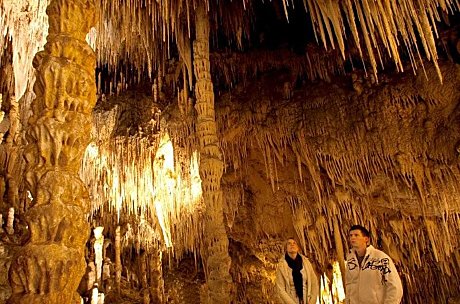
Hastings Cave Near Cockle Creek
                                           
             Tasmania has some of the longest and deepest cave systems of any Australian state, and some of the most diverse and unusual subterranean fauna in the world. Ecologically, caves are somewhat analogous to islands, in the sense that both experience isolation from the outside, which allows for increased endemicity, or creatures that evolve in one place and are found nowhere else. Tasmanian Cave animals include "spiders, crickets, beetles, slaters, snails, harvestmen, millipedes, pseudoscorpions and many other invertebrates." 
            The Tasmanian Cave Spider, Hickmania Troglodytes, has become an iconic species for conservation. With a legspan up to 18cm (that's 7 inches!), it is the largest spider in Australia. It lives near the entrances, twilight and transition zones of caves, and eats primarily cave crickets. Apparently it can live up to two or three decades, an order of magnitude longer than other spider species, and has an unusual reproductive behavior in which the female guards a silk-wrapped eggsack for almost a year before the eggs hatch (As with some other spiders, however, mating is dangerous for males, who sometimes end up a post-mating snack for the females!). 
            These unusual features help mark the Tasmanian Cave Spider as a distinct subfamily of arachnid. They are some of the last surviving remnants of a Gondwanan subfamily, and their closest relatives live in Chile. Adapting to live in caves has allowed this evolutionarily distinct lineage to survive for millions of years after their relatives went extinct. We might be seeing more of them soon, as fantasy-horror writer Neil Gaiman is making a documentary about them. 
         

             Places that would be cool to go: Mole Creek Cave, Hastings Cave and Thermal Springs, Gunns Plains Cave.
Articles: http://www.parks.tas.gov.au/indeX.aspX?base=24499, http://www.abc.net.au/news/2015-01-17/author-neil-gaiman-drawn-to-film-about-tasmanian-cave-spider/6020080

Saturday, January 10, 2015

Salmon Aquaculture and its Discontents

           
Teach a man to fish and he eats for a day. Teach a man to farm fish, and he either creates jobs and supports healthy food production, or he pollutes the seacoast, poisons consumers, devastates marine ecosystems and drives small businesses to bankruptcy.
          These are the competing narratives surrounding Tasmanian salmon producers recent announcement of plans to double the industry's scale by 2030. Salmon aquaculture in Tasmania was a $350 million dollar industry in 2009, and demand has only skyrocketed since, bolstered by advertising campaigns highlighting the pristine Tasmanian coastline and health benefits of a high-omega-3 diet. To meet this demand without overfishing wild populations, aquaculture scientists breed baby salmon in hatcheries and grow them offshore in circular pens, which can hold up to 50,000 fish a piece.
               Clearly any industry of this scale will have some environmental costs. Activist groups have used underwater footage of cloudy water near the fish pens to show that faeces and fish feed are contaminating the water. One major concern is Tasmania's kelp forests, like those near Lady Bay south of Hobart, which are home to abalone (an important rival industry) and an important habitat for many species of fish, invertebrates and marine mammals. Health is also a concern, as some aquaculture opponents argue the antibiotics given to farmed fish can cause health problems for humans, including breeding anti-biotic-resistant superbugs.
                 Critics urge a halt to salmon expansion until monitoring and coastal planning mechanisms are in place to protect these ecosystems. One possible sign of hope comes from new technologies aimed at making aquaculture more sustainable, including off-shore pens situated near currents that can diffuse the concentration of nutrients generated by feed and fish waste.
Here are two articles: http://www.abc.net.au/news/2014-09-30/controversial-plans-to-expand-tasmanian-farmed-salmon-industry/5780140 and http://www.abc.net.au/7.30/content/2009/s2766962.htm - Aaron Peterson